
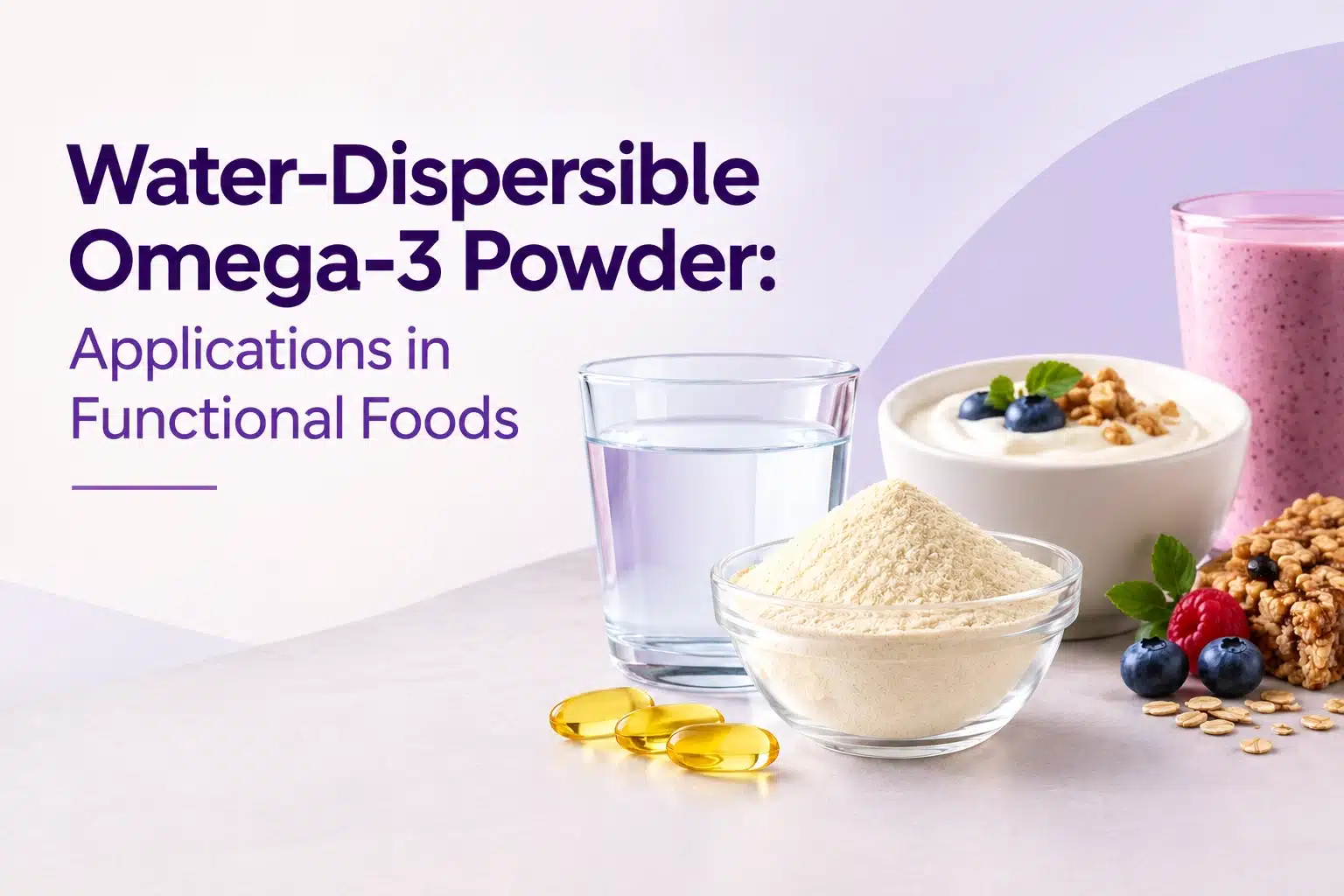
Fortifying everyday foods and beverages with omega-3s sounds simple in principle. Consumers want the heart and brain health benefits of EPA and DHA, and manufacturers want a differentiated, better for you product line. In practice, liquid omega-3 oils are notoriously difficult to work with. They oxidize quickly, carry a fishy taste and odor, and do not mix into water based systems. Water-dispersible omega-3 powder solves each of these problems, which is why it has become the go to format for fortifying dairy, bakery, beverages, and other functional food categories. This guide covers how the technology works and where it is being used.
The Core Problem: Why Raw Omega-3 Oil Does Not Work in Food
Omega-3 fatty acids such as EPA and DHA are highly unsaturated, which makes them nutritionally valuable but also chemically unstable. Exposed to oxygen, heat, or light, they oxidize rapidly, producing off flavors and reducing potency. That is a serious problem for products that sit on a shelf or move through a bakery oven or pasteurizer.
On top of that, oil and water do not mix, so simply adding fish or algae oil to a beverage or dairy base creates separation, an unpleasant mouthfeel, and inconsistent dosing.
How Microencapsulation Creates a Water-Dispersible Powder
The solution is microencapsulation. The omega-3 oil is enclosed inside a protective coating, or wall material, typically built from food grade proteins and carbohydrates.
According to a recent review of encapsulation technology, encapsulation technologies pack omega-3 oils into engineered colloidal particles made from food grade ingredients such as liposomes, emulsion droplets, or microgels; these can be used in liquid form or converted into a powder through spray drying, which extends shelf life and makes the ingredient far easier to handle in a food production environment. nih
The choice of wall material matters. As one industry review notes, a range of methods, both physical and chemical, are used to encapsulate omega-3s, and selecting the right approach depends on economic factors, the sensitivity of the oil, the target capsule size, and the physical and chemical properties of both the coating and the core oil.
Common wall materials include gum arabic, whey protein, gelatin, and modified starches. A 2025 industry trend analysis notes a growing shift toward clean label wall materials such as rice starch and pea protein as brands respond to consumer demand for recognizable ingredient lists. nihOxford Academic
Emerging nanoencapsulation techniques go a step further. Researchers developing omega-3 fortified yogurt found that nanoemulsion techniques, which trap oil within an aqueous phase, produce smaller droplets with improved dispersion in food systems, better protection against oxidative deterioration, and enhanced bioavailability compared with conventional emulsification. Springer
Why Water-Dispersible Omega-3 Powder Performs in Food Manufacturing
Once encapsulated into a powder, omega-3s gain several manufacturing advantages that raw oil cannot offer.
- Processing stability. Encapsulated powders can withstand baking, pasteurization, and other thermal processing steps far better than free oil, because the wall material acts as a physical barrier against oxygen and heat.
- Instant dispersibility. For beverage and liquid applications, dispersibility is a defining requirement. Industry analysts point to innovation in beverage fortification requiring powders with instant dispersibility and no sedimentation as a major driver of adoption across ready to drink categories. Oxford Academic
- Sensory neutrality. Encapsulation masks the fishy taste and smell that has historically limited omega-3 fortification in mainstream food products, allowing brands to fortify without compromising flavor.
- Extended shelf life. By isolating the oil from oxygen, encapsulated powders resist rancidity far longer than liquid oil blended directly into a formulation.
Where the Format Is Being Used
Functional food and beverage brands are fortifying a broad and growing range of products with omega-3 powder. A 2026 market analysis highlights fortification of everyday staple foods, such as bread, pasta, and breakfast cereals, for mass market reach, alongside continued growth in dairy and ready to drink beverage applications.
In clinical and pilot research, a small trial delivering microencapsulated omega-3s in a breakfast meal at a dose of 450 to 550 mg of combined EPA and DHA produced a measurable rise in plasma DHA levels and a reduction in triacylglycerols after just two weeks, a proof point for how well the format delivers omega-3s even in an ordinary food matrix. Oxford Academicuspto
Encapsulation technology is not limited to human food either. The same core science underpins microencapsulated omega-3 powders used in animal feed, where a water soluble wall material protects the enclosed algae or fish oil from oxidation while remaining easy for digestive enzymes to break down, which shows how versatile the format is across categories. Chibiotech
Choosing a Powder for Your Application
Not all omega-3 powders are equal. When evaluating a supplier or ingredient, food and beverage manufacturers should confirm:
- Dispersion performance in your specific base, whether that is water, dairy, or batter. Ask for stability data, not just a spec sheet.
- Oxidative stability under your actual processing conditions, including baking temperature, pasteurization hold time, and shelf life target.
- Wall material composition, and whether it aligns with clean label positioning if that matters to your brand.
- EPA/DHA concentration and source (fish vs. algal oil), since this determines both the nutritional claim you can make and the allergen or dietary profile of the finished product.
Conclusion
Water-dispersible omega-3 powder has removed the biggest technical barriers that once kept omega-3 fortification confined to capsules and liquid supplements. For food and beverage manufacturers looking to build a credible brain health or heart health claim into mainstream products, it is now a proven, scalable ingredient format.
Sources
- Microencapsulated Omega-3 Powders Market Fueled by Demand in Infant Formula and Clinical Nutrition to 2035. IndexBox.
https://www.indexbox.io/blog/microencapsulated-omega-3-powders-market-driven-by-mainstream-functional-food-fortification-through-2035/ - Development of omega-3 fortified stirred yoghurt with enhanced sensory and oxidative qualities through the addition of fish oil nanoemulsion and fruits. International Journal of Food Science and Technology, Oxford Academic.
https://academic.oup.com/ijfst/article/60/1/vvae034/7943315 - Encapsulated Omega-3 Delivery Systems in Functional Foods. Springer Nature Link.
https://link.springer.com/chapter/10.1007/978-1-0716-4346-4_13 - Kassem, et al. Micro and Nanoencapsulation of Omega-3 Fatty Acids: Functional Applications and Future Perspectives in Food Systems. Food Safety and Health, Wiley Online Library.
https://iadns.onlinelibrary.wiley.com/doi/10.1002/fsh3.70071 - Encapsulation and Protection of Omega-3-Rich Fish Oils Using Food-Grade Delivery Systems. PMC.
https://www.ncbi.nlm.nih.gov/pmc/articles/PMC8305697/ - Microencapsulated foods as a functional delivery vehicle for omega-3 fatty acids: a pilot study. PMC.
https://www.ncbi.nlm.nih.gov/pmc/articles/PMC2694142/ - Microencapsulated omega-3 oil powder for animal feed. US Patent/USPTO filing.
https://image-ppubs.uspto.gov/dirsearch-public/print/downloadPdf/9730907