
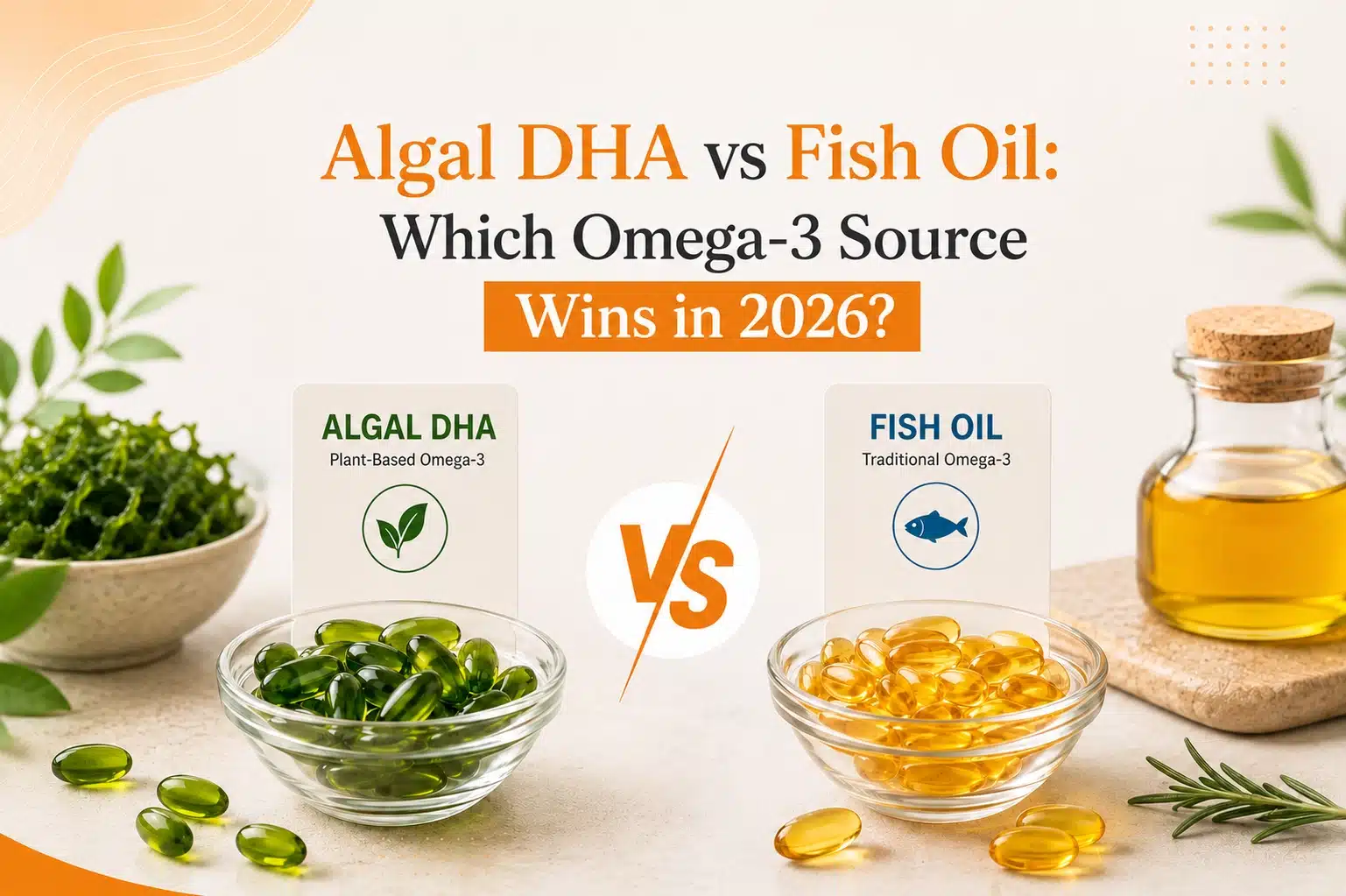
Algal DHA vs Fish Oil is no longer a simple question of choosing an alternative to the traditional omega-3 source. For decades, fish oil was the default answer whenever anyone asked how to get DHA and EPA — the omega-3 fatty acids essential for brain, heart, and eye health. But 2026 tells a different story. Between clinical evidence, sustainability data, and shifting consumer demand, algal DHA has moved from “alternative” to genuine category leader. For nutraceutical brands and D2C buyers deciding what goes into their next formulation, here’s why the science increasingly favors algae.
The Bioavailability Question Is Settled
The biggest hesitation brands used to have about algal DHA was simple: does it actually work as well as fish oil in the body? Recent clinical research has answered that directly.
A randomized, double-blind, placebo-controlled trial published in 2025 tracked 74 adults over 14 weeks and measured how much DHA and EPA actually showed up in blood plasma after supplementation. The result: algal oil performed on par with fish oil, with no meaningful difference in how well the body absorbed and used the omega-3s from either source.
There’s a good biological reason for this — fish don’t manufacture EPA and DHA themselves. They accumulate it by eating microalgae, or by eating smaller fish that ate microalgae further down the food chain. Algae is the original source. Sourcing DHA directly from it simply removes the middleman.
Where Fish Oil Falls Short: Purity and Contamination
This is where the comparison stops being close. Fish oil is drawn from marine environments that are, by definition, exposed to whatever pollutants are in the ocean today. Independent research has repeatedly flagged fish oil as a carrier of heavy metals, antibiotic residues, and other contaminants that raise real safety questions for consumers.
Algal oil, grown in closed, controlled cultivation systems, sidesteps this problem structurally rather than through filtering after the fact — because the algae never touches open ocean water in the first place, it never picks up the pollutants that accumulate in marine food chains.
At AlgalR, this shows up in hard numbers, not just claims. Our Biosus OMEGA algal DHA is cultivated in controlled fermenters, keeping it free from dioxins and PCBs — common toxins associated with marine-sourced oils. Heavy metals sit below detectable limits (<BDL), compared to fish oil batches that are frequently rejected over heavy metal contamination.
There’s no exposure risk from steroids, pesticides, or antibiotics either, since the entire process happens in a closed cultivation environment rather than an open ocean.
Sustainability: The Argument That’s Getting Harder to Ignore
Fish oil production is tied directly to the health of ocean ecosystems — and those ecosystems are under visible strain.
In 2025, the Antarctic krill fishery, a major source of marine omega-3s, was shut down early for the first time in its history after its entire annual catch limit was reached months ahead of schedule. That kind of disruption is a stark signal of how contested marine omega-3 supply chains have become.
Algae production, by contrast, doesn’t depend on ocean stocks at all. It scales in controlled facilities, and production timelines are dramatically shorter — a batch of omega-3-producing algae can be cultivated in roughly 25 days, compared to close to two years for a comparable fish-based supply chain.
That’s not a marginal efficiency gain; it’s a fundamentally different, more resilient supply model — one that matters increasingly to D2C brands whose customers actively look for sustainability credentials on the label.
Vegetarian, Allergen-Free, and Formulation-Friendly
Beyond the science, algal DHA solves a practical formulation problem fish oil simply can’t: it’s 100% vegetarian and allergen-free, making it usable across vegan, vegetarian, and allergen-conscious product lines without compromise.
AlgalR’s DHA and EPA are derived from wild-type Indian microalgae using patented, solvent-free extraction, manufactured under FSSC22000 and FSSAI-compliant processes, with purity levels tailored from 10% to 60% depending on formulation needs.
The Bottom Line for Algal DHA vs Fish Oil in 2026
When you line up the evidence — comparable bioavailability, significantly lower contaminant risk, better oxidative stability, and a sustainability profile that doesn’t depend on strained ocean ecosystems — algal DHA isn’t just keeping pace with fish oil anymore. It’s addressing the exact weaknesses that have made fish oil a harder sell for health-conscious, sustainability-minded consumers.
For nutraceutical brands building the next generation of omega-3 products — whether for human nutrition, pet health, or aquaculture — the direction of the science and the market are pointing the same way. AlgalR has spent over a decade turning that direction into a reliable, export-ready supply chain, backed by 11+ years of algal omega-3 expertise and DSIR-certified R&D since 2014.
Looking to formulate with clean-label, vegetarian DHA and EPA?
Get in touch with AlgalR to explore custom omega-3 solutions for your brand.
References
- Bailey, E., Wojcik, J., Rahn, M., Roos, F., Spooren, A., & Koshibu, K. (2025). Comparative Bioavailability of DHA and EPA from Microalgal and Fish Oil in Adults. International Journal of Molecular Sciences. DOI: 10.3390/ijms26199343. Available via PubMed: https://pubmed.ncbi.nlm.nih.gov/41096614/ and PMC: https://www.ncbi.nlm.nih.gov/pmc/articles/PMC12524788/
- GlobalRPH (2025). Comparative Analysis of Fish Oil and Algae-Based Omega-3 Supplements. https://globalrph.com/2025/07/comparative-analysis-of-fish-oil-and-algae-based-omega-3-supplements/
- NiaHealth (2025). Fish Oil vs. Algae Oil: Which Omega-3 Is Better for You? https://niahealth.co/blog/posts/fish-oil-vs-algae-oil-which-omega-3-is-better-for-you
- Calgee (2026). Algae Oil vs Fish Oil: A Complete 2026 Guide — covers the 2025 Antarctic krill fishery closure and algae vs. fish production timelines. https://calgee.com/a/blog/algae-oil-vs-fish-oil
- AlgalR (2026). Company data on Biosus OMEGA algal DHA — heavy metals, toxin profile, oxidation stability, and certifications (FSSC22000:V6, FSSAI). https://algalr.com/
Note: Sources 2–4 are industry/science-journalism summaries rather than peer-reviewed papers; they’re included for the sustainability and contamination context they cite, but source 1 (the peer-reviewed RCT) is the primary clinical evidence behind the bioavailability claims in this post. Anyone republishing this content for regulatory-sensitive claims (e.g., infant/maternal safety) should verify current peer-reviewed literature directly rather than relying on this summary alone.