
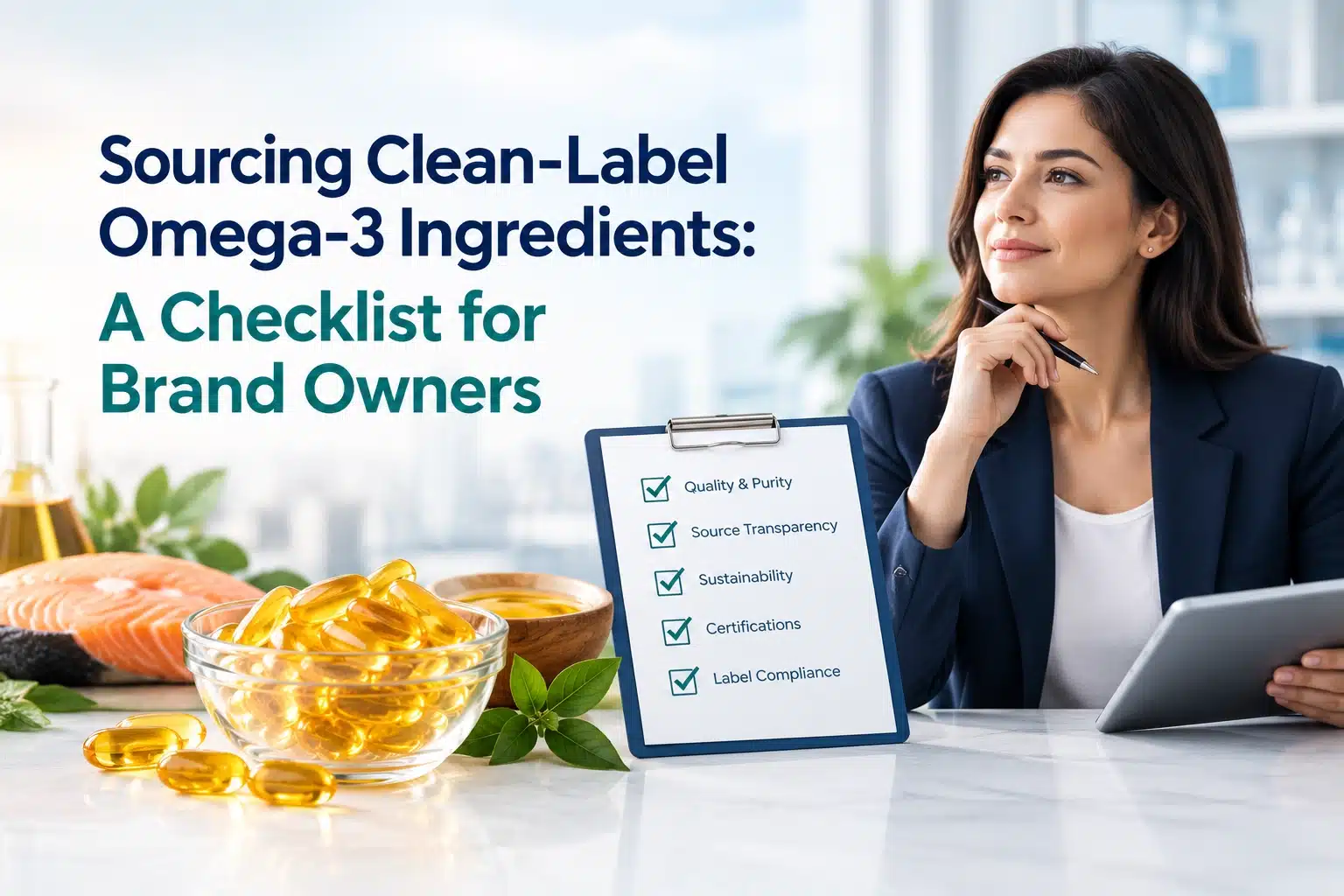
Clean-label omega-3 ingredients are becoming increasingly important as consumer interest in recognisable ingredients and transparent sourcing grows, giving procurement teams an increasingly important role in determining what ultimately appears on a product label.
For brands developing dietary supplements, functional foods, beverages or other nutrition products containing omega-3s, sourcing involves much more than comparing price per kilogram. The omega-3 source, EPA and DHA specifications, oxidation control, contaminant testing, traceability, documentation, manufacturing standards, and formulation compatibility can all influence an ingredient’s suitability.
So, what should procurement teams look for when choosing a clean label omega-3 ingredient supplier?
Here is a practical checklist to support the sourcing process.
1. Start With the Source of the Omega-3
One of the first questions to ask is: Where does the omega-3 come from?
EPA (eicosapentaenoic acid) and DHA (docosahexaenoic acid) are long-chain omega-3 fatty acids. Although they are commonly associated with fish, the U.S. National Institutes of Health (NIH) notes that microalgae at the base of the marine food chain originally synthesise EPA and DHA; fish acquire and accumulate these fatty acids through the food chain. Office of Dietary Supplements
For brands interested in vegetarian formulations, algal oil provides an alternative source. The NIH specifically identifies algal oil as a vegetarian source of omega-3s. Office of Dietary Supplements
A procurement team should clearly establish the source and determine whether it aligns with the finished product’s positioning and formulation requirements.
2. Define What “Clean Label” Means for Your Brand
“Clean label” can mean different things to different brands and consumers. It is therefore useful to turn the concept into a clear internal procurement specification rather than relying on the phrase alone.
For clean-label omega-3 ingredients, your specification might address ingredient origin, ingredient list simplicity, vegetarian requirements, additives, carriers, antioxidants, allergens, processing considerations and documentation.
This helps suppliers respond to objective criteria and allows procurement, R&D, regulatory and marketing teams to evaluate an ingredient consistently.
Importantly, clean label should not be confused with an absence of necessary quality or stability measures. For example, the GOED Voluntary Monograph recognizes that an approved food antioxidant may be added to improve the stability of an omega-3 product. GOED Omega-3
3. Confirm the EPA and DHA Specification
Not every omega-3 ingredient has the same fatty-acid profile.
Depending on the application, a brand may require DHA as the predominant omega-3, EPA as the predominant omega-3 or a specific combination of the two.
Ask potential suppliers for clear specifications covering the amount or concentration of DHA, EPA and total omega-3s, as relevant to the ingredient.
This is particularly important when comparing quotations. Two omega-3 oils offered at different prices may also provide substantially different concentrations or specifications.
A meaningful commercial comparison should therefore consider the required amount of active omega-3—not price alone.
4. Ask for a Certificate of Analysis
Documentation should be central to ingredient procurement.
Request an appropriate Certificate of Analysis (CoA) and review whether it provides the information needed to verify the ingredient against your agreed specification.
For dietary supplements in the United States, FDA’s CGMP guidance describes requirements surrounding supplier qualification and reliance on supplier certificates of analysis. Among other points, it discusses test or examination methods, limits and actual results, supplier qualification documentation and periodic reconfirmation when relying on a supplier’s CoA for applicable components. U.S. Food and Drug Administration
Even where a different regulatory framework applies, this provides a useful principle for procurement teams: documentation should support verification rather than simply accompany a shipment.
5. Examine Oxidative Quality
Omega-3 oils are rich in polyunsaturated fatty acids and therefore require appropriate attention to oxidative quality and handling.
Procurement teams should discuss the supplier’s specifications, testing methods, packaging, storage conditions and shelf-life information.
The GOED Voluntary Monograph, an established omega-3 industry quality standard, specifically focuses on oxidative quality, environmental contaminants and measurement of EPA and DHA. GOED Omega-3
For brand owners, this means oxidative quality deserves its own place on the supplier assessment checklist rather than being treated as a secondary consideration.
6. Review Contaminant and Purity Testing
Ingredient quality also requires knowing what should not be present beyond acceptable limits.
Ask suppliers what contaminant and purity parameters are routinely tested, which analytical methods are used and whether relevant test results can be supplied.
Requirements will depend on the product, market and applicable regulations. Procurement teams should therefore work with their quality and regulatory colleagues to establish appropriate specifications before final supplier approval.
Independent standards can provide useful benchmarks. Again, the GOED Monograph addresses environmental contaminants as one of its core omega-3 quality parameters. GOED Omega-3
7. Check Manufacturing and Quality Systems
A strong ingredient specification needs to be supported by a reliable manufacturing system.
When assessing a potential clean label omega-3 ingredient supplier, ask about manufacturing practices, quality-control procedures, facility standards and certifications relevant to your target markets.
For the U.S. market, FDA Current Good Manufacturing Practices address areas including facility conditions, sanitation, equipment and production/process controls. U.S. Food and Drug Administration
The exact documentation you require will depend on your product category and destination market, but the underlying procurement question remains straightforward:
Can the supplier consistently manufacture the ingredient to the agreed specification?
8. Look for Traceability
Traceability matters throughout the ingredient supply chain.
Procurement teams should understand whether an ingredient can be traced through production batches and supporting records.
FDA’s dietary-supplement CGMP guidance, for example, discusses unique identifiers for component lots so they can be traced to information including the supplier, receipt date, component and subsequent use. U.S. Food and Drug Administration
Ask suppliers about their lot-number system, production records, CoA linkage and procedures for investigating quality issues.
Good traceability gives brand owners greater visibility into the ingredients entering their products.
9. Evaluate the Ingredient Format
Choosing the right omega-3 is not only about its nutritional profile. It also needs to work in the intended finished product.
Depending on the formulation, manufacturers may require oil, powder or another delivery format.
Procurement teams should therefore involve product-development colleagues early and consider factors such as concentration, sensory characteristics, stability, processing conditions, storage requirements and compatibility with the intended application.
A technically excellent ingredient is only useful if it performs effectively within the final formulation.
10. Assess the Clean-Label Omega-3 Ingredient Supplier, Not Just the Ingredient
The final checkpoint is the supplier itself.
A dependable supplier should be able to provide technical documentation, product specifications, quality information and appropriate support during product development and commercial supply.
Procurement teams may also want to evaluate production capacity, lead times, minimum order quantities, packaging options, continuity of supply and responsiveness to technical questions.
Price remains important—but procurement value is broader than the initial quotation.
A reliable supply relationship can contribute to consistency from formulation through commercial production.
A Practical Procurement Checklist
Before approving a clean-label omega-3 source, procurement teams can work through these core questions:
- What is the original source of the EPA and/or DHA?
- Does it meet our internal definition of clean label?
- Is it suitable for our intended vegetarian or other product positioning?
- What are the EPA, DHA and total omega-3 specifications?
- Is a batch-specific Certificate of Analysis available?
- How is oxidative quality evaluated?
- Which relevant contaminants and purity parameters are tested?
- What quality systems and certifications support manufacturing?
- Is there clear batch and supply-chain traceability?
- Does the ingredient format work in our formulation?
- What storage conditions and shelf life apply?
- Can the supplier provide dependable technical and commercial support?
Choosing the Right Clean Label Omega-3 Ingredient Supplier
Successful sourcing is ultimately about bringing quality, transparency, formulation requirements and supply reliability together.
For procurement teams, the strongest approach is to establish measurable requirements first and then assess potential suppliers against those requirements. This turns “clean label” from a broad marketing concept into a practical sourcing framework for evaluating clean-label omega-3 ingredients.
For brands exploring plant-based omega-3 solutions, microalgae are particularly relevant because they are the original producers of EPA and DHA in the marine food chain. Office of Dietary Supplements
AlgalR: Microalgae-Based Omega-3 Solutions
AlgalR specialises in microalgae-derived omega-3 ingredients, including vegetarian DHA and EPA solutions. For brand owners and procurement teams evaluating algae-based omega-3 ingredients, AlgalR can support discussions around ingredient specifications and formulation requirements.
Brands interested in sourcing can contact AlgalR directly to discuss the appropriate ingredient and documentation for their intended application.
AlgalR – Factory: S. No. 259/1Q1, 1Q2, 1R1, 1R2, Palayapatti – North, Budalur Taluk, Thanjavur – 613 402, Tamil Nadu, India
Phone: +91 94898 47425 / +91 88701 64876
Email: salesanpl@camlinfs.com
References
- NIH Office of Dietary Supplements – Omega-3 Fatty Acids: Health Professional Fact Sheet
https://ods.od.nih.gov/factsheets/Omega3FattyAcids-HealthProfessional/ - NIH Office of Dietary Supplements – Omega-3 Fatty Acids: Consumer Fact Sheet
https://ods.od.nih.gov/factsheets/Omega3FattyAcids-Consumer/ - GOED – The GOED Voluntary Monograph
https://goedomega3.com/goed-monograph - U.S. FDA – Current Good Manufacturing Practices (CGMPs) for Food and Dietary Supplements
https://www.fda.gov/food/guidance-regulation-food-and-dietary-supplements/current-good-manufacturing-practices-cgmps-food-and-dietary-supplements - U.S. FDA – Dietary Supplement CGMP Compliance Guide
https://www.fda.gov/regulatory-information/search-fda-guidance-documents/small-entity-compliance-guide-current-good-manufacturing-practice-manufacturing-packaging-labeling