
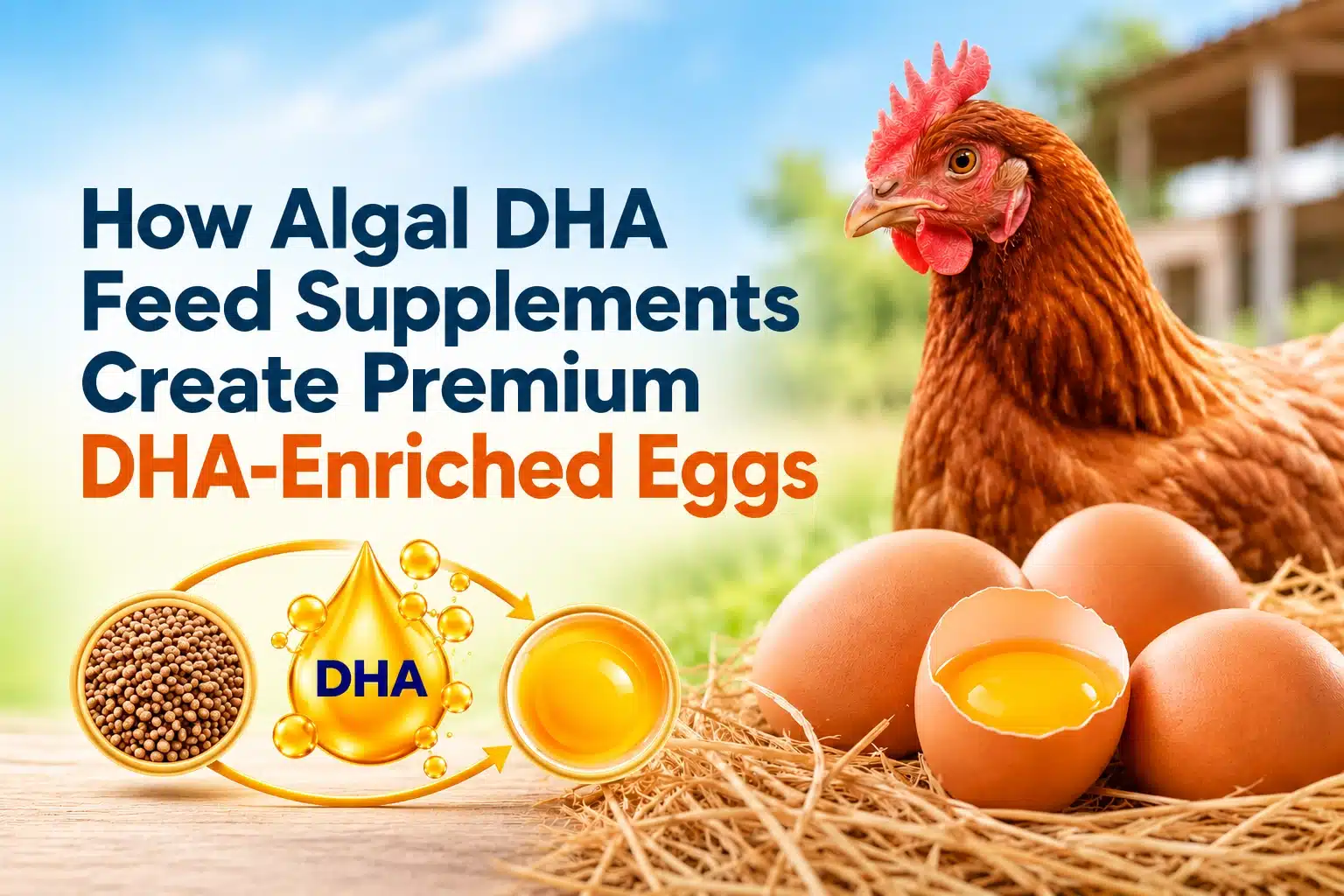
As Indian consumers look more closely at what their food delivers, the everyday table egg is being repositioned. One industry forecast expects India’s egg market to grow from USD 8.0 billion in 2025 to USD 13.8 billion by 2032, with growth moving towards graded, branded and nutrient-enriched eggs. Ken Research
For poultry integrators, this creates an opportunity to move part of the flock away from price-driven commodity trading and into a premium, nutrition-led product. DHA-enriched eggs are one of the most established routes.
But a premium egg depends on what goes into the hen. So, what does it take to become a trusted DHA enriched eggs supplier?
Here is a practical guide to how algal DHA feed supplements make it possible.
1. Start With Why DHA Matters
DHA (docosahexaenoic acid) is a long-chain omega-3 fatty acid. The U.S. National Institutes of Health (NIH) notes that microalgae at the base of the marine food chain originally synthesise EPA and DHA; fish acquire them through the food chain. Office of Dietary Supplements
Plant foods such as flaxseed provide ALA, a different omega-3. The body can convert some ALA into DHA, but not a significant amount. WebMD
This leaves a gap for the many Indian consumers who eat eggs but not fish. An egg is affordable, eaten daily and already trusted, which makes it a practical everyday vehicle for DHA.
2. Understand How DHA Moves From Feed to Yolk
A laying hen transfers DHA from her diet into the egg yolk. Feed her a consistent DHA source, and every egg becomes a delivery vehicle.
Research on microalgae shows this clearly:
- Layers fed 2% Schizochytrium microalgae for eight weeks produced eggs with more than 100 mg DHA per egg, higher than hens fed 4% fish oil. Journal of Applied Animal Nutrition
- Feeding 0.8% microalgal DHA oil delivered 160 mg DHA per egg in Cornell University research. Cornell eCommons
- Yolk DHA rose in line with the amount of algae fed. University of Kentucky
This dose-response relationship matters. It allows a nutritionist to set a DHA target per egg and formulate the ration to reach it.
3. Compare the Omega-3 Sources
Integrators have used several omega-3 sources in layer diets. Each behaves differently in the hen.
Flaxseed and other ALA-rich seeds raise ALA, but conversion to DHA is limited. In the same Cornell research, 10% hempseed meal raised yolk DHA to about 58 mg per egg, compared with 160 mg from algal oil. Cornell eCommons
Fish oil supplies DHA, but it has proven hard to exceed 100 mg DHA per egg without palatability problems. Its supply is also tied to declining fish stocks. Animals (PMC), US Patent 11077158
Algal DHA comes directly from the original producer. It is renewable, traceable and algae-based, so the resulting eggs also suit ovo-lacto vegetarian consumers. Canadian Poultry Magazine
4. Protect Flock Performance and Egg Quality
A premium egg must be produced without sacrificing flock performance.
A 10-week Poultry Science study fed Lohmann LSL lite hens two algal oils. Egg DHA rose from 84 mg to as much as 297 mg per 100 g of egg, with no adverse effects on egg production or eggshell quality. Poultry Science
Egg weight and shell quality were also unaffected in the University of Kentucky trial. University of Kentucky And for the shopper, the enriched eggs still look and taste the same as conventional eggs. Canadian Poultry Magazine
5. Back Every Label Claim With Testing
A premium price depends on a claim the consumer can trust.
In the UK, St Ewe Eggs sends its algae-fed eggs for nutritional testing every 12 weeks, to support its claim that two eggs provide 65% of the reference intake for DHA. Poultry World
In India, nutrition claims on food fall under the Food Safety and Standards (Advertising and Claims) Regulations, 2018. FSSAI Integrators should therefore set a DHA target, test eggs regularly and review every label claim against these regulations before launch.
A Practical Checklist for Integrators
Before launching a DHA egg line, work through these questions:
- What DHA level per egg are we targeting?
- Is the DHA content of the feed supplement standardised?
- Is a batch-specific Certificate of Analysis available?
- Is the source vegetarian, traceable and consistent?
- What certifications support the manufacturing process?
- Can the supplier advise on inclusion rates and egg testing?
- Is supply local, reliable and scalable?
Becoming a Trusted DHA Enriched Eggs Supplier
Successful DHA egg programmes bring together a consistent DHA source, a clear target per egg, regular testing and a reliable supply partner.
For integrators, algal DHA offers a direct route from the original source of omega-3 to the yolk, without the palatability and supply limits of fish oil. It turns a commodity egg into a premium product that can be measured, labelled and trusted.
AlgalR: Algal DHA for Poultry Nutrition
AlgalR, a Camlin Fine Sciences company, manufactures microalgae-derived DHA at its facility in Thanjavur, Tamil Nadu. Its production uses patented technology, partly supported by BIRAC, and follows FSSAI, CODEX and FSSC 22000 Version 6. BIRAC
For poultry, AlgalR supplies vegetarian algal DHA biomass with 10–25% DHA, giving integrators a domestic, traceable DHA source for egg enrichment.
Integrators planning a DHA egg programme can contact AlgalR directly to discuss specifications, inclusion rates and layer trials.
AlgalR – Factory: S. No. 259/1Q1, 1Q2, 1R1, 1R2, Palayapatti – North, Budalur Taluk, Thanjavur – 613 402, Tamil Nadu, India
Phone: +91 94898 47425 / +91 88701 64876
Email: salesanpl@camlinfs.com
References
- Ken Research – India Eggs Market Size, Share & Forecast, 2026–2032
https://www.kenresearch.com/industry-reports/india-eggs-market.md - NIH Office of Dietary Supplements – Omega-3 Fatty Acids: Health Professional Fact Sheet
https://ods.od.nih.gov/factsheets/Omega3FattyAcids-HealthProfessional/ - WebMD – Algal Oil: Are There Health Benefits?
https://www.webmd.com/diet/health-benefits-algal-oil - Journal of Applied Animal Nutrition – Effects of dietary microalgae (Schizochytrium spp.) and fish oil in layers on DHA enrichment of the eggs
https://cambridge.org/core/journals/journal-of-applied-animal-nutrition/article/effects-of-dietary-microalgae-schizochytriumspp-and-fish-oil-in-layers-on-docosahexaenoic-acid-omega3enrichment-of-the-eggs/35DE0BF1C139037EE9A322F3B7BBE7C5 - Cornell University eCommons – Egg biofortification with DHA in laying hens
https://ecommons.cornell.edu/entities/publication/da1ffed5-9e8f-4bf2-9294-34de49479055 - University of Kentucky – Effects of supplementing microalgae in laying hen diets on productive performance, fatty-acid profile and oxidative stability of eggs
https://scholars.uky.edu/es/publications/effects-of-supplementing-microalgae-in-laying-hen-diets-on-produc/ - US Patent 11077158 – Omega-3 fatty acid enrichment of poultry products with defatted microalgae animal feed
https://image-ppubs.uspto.gov/dirsearch-public/print/downloadPdf/11077158 - Animals (PMC) – Tolerance of broilers to dietary supplementation with the DHA-rich microalga Aurantiochytrium limacinum
https://www.ncbi.nlm.nih.gov/pmc/articles/PMC6211075/ - Canadian Poultry Magazine – Algae for healthier eggs
https://www.canadianpoultrymag.com/algae-for-healthier-eggs-30126/ - Poultry Science (2023) – Egg production, egg quality and fatty acid profiles in eggs and tissues in Lohmann LSL lite hens fed algal oils rich in DHA
https://doi.org/10.1016/j.psj.2023.102921 - Poultry World – Omega-3 from algae for nutritious eggs
https://poultryworld.net/health-nutrition/omega-3-from-algae-for-nutritious-eggs - FSSAI – Compendium: Food Safety and Standards (Advertising and Claims) Regulations, 2018
https://fssai.gov.in/upload/uploadfiles/files/Compendium_Advertising_Claims_Regulations_16_11_2021.pdf - BIRAC – Algal DHA production (AlgalR NutraPharms)
https://www.birac.nic.in/product-detail.php?product=170 - IndiaMART – Algalr Nutrapharms Private Limited
https://m.indiamart.com/algalrnutrapharms/ - AlgalR – Contact Us
https://algalr.com/contact-us/